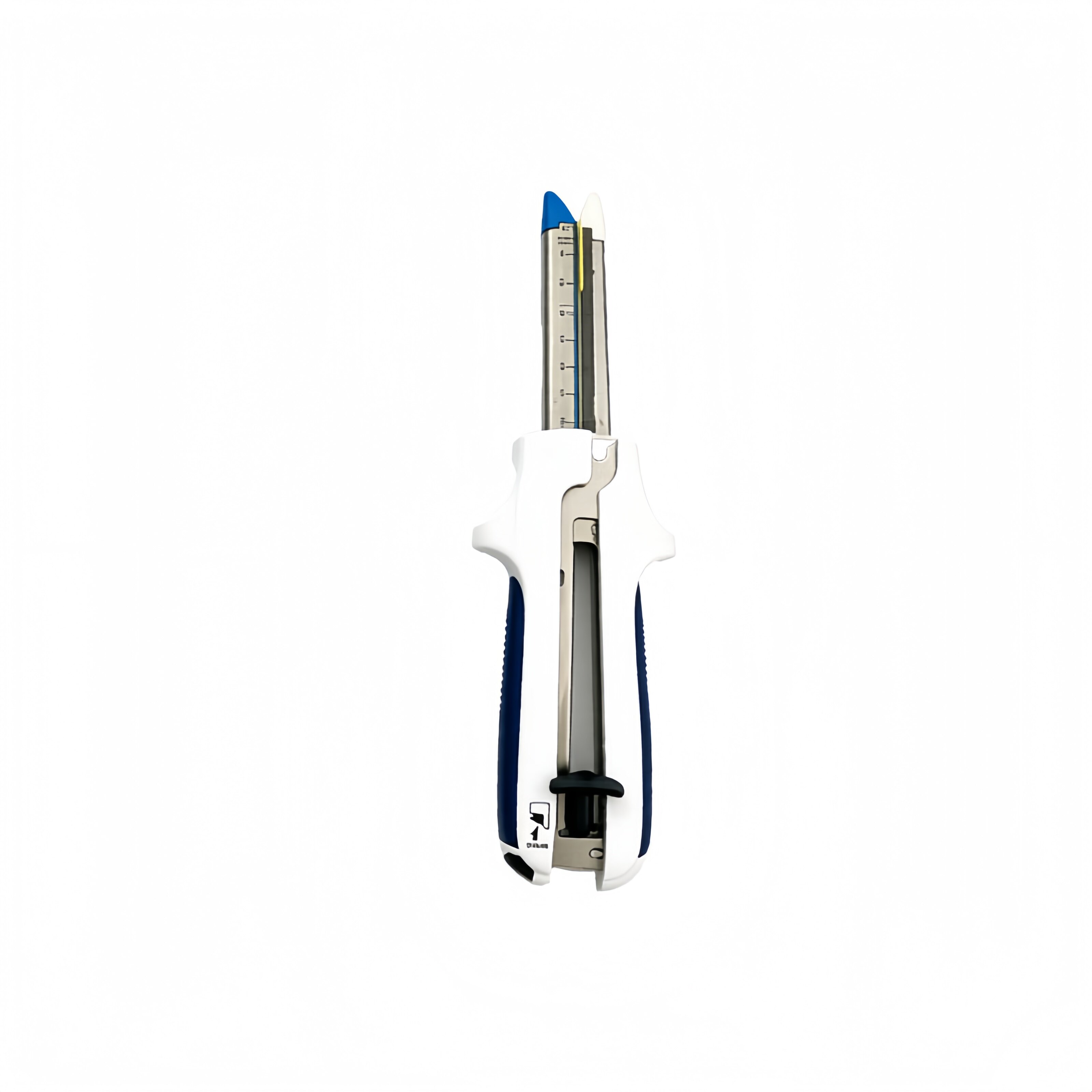
Veterinary Linear Cutter and Stapler with Components
Open surgical stapling for tubular organs: simple and reliable operation.
Product Basic Information
| Product Name | Veterinary Linear Cutter and Stapler with Components |
| Standard | Q/SCZL 004-2026 |
| Registered Entity | Shanghai Shenchuang Zhilian Trading Co., Ltd. |
| Device Type | Sterile Disposable Veterinary Surgical Instruments |
| Sterilization Method | Ethylene Oxide Sterilization |
Full Specifications
| Effective Suture Length | 55–10 mm |
| Organ thickness compatibility | 1.5~2.0mm |
| Color indicator | Blue/Green |
| Number of staple cartridge slots | 60–104 |
| Nail Height | 3.8–4.5mm |
| Main Material | Medical-grade stainless steel + PC |
| Sterilization Method | Ethylene Oxide Sterilization |
| Packaging Specifications | 1 pcs/box (includes cartridge assembly) |
Compatible Animals
Applicable Scenarios
Suitable for gastrointestinal, urinary, and respiratory tract surgeries in dogs, cats, pigs, cattle, sheep, and companion animals. Enables simultaneous tissue cutting and anastomotic closure. Used for intestinal transection and anastomosis, organ resection, and tubular tissue suturing.
Not applicable:Not suitable for calcified or hardened tissues, extremely thin and fragile mucosa, excessively thick tissues, or organs with excessive tension that prevent proper approximation.
Product Performance Features
- 1The device has a smooth, burr-free, and scratch-free exterior with clear, aligned surface markings. Staples are smooth, free of burrs, and dent-free.
- 2Metal outer surface roughness Ra ≤ 0.8 μm; metal components show no rust or discoloration after 2-hour neutral salt spray corrosion test.
- 3Easy to assemble and disassemble with secure positioning; staples remain in the cartridge even after shaking. Smooth opening and closing without jamming.
- 4Sharp cutting blade with cutting force ≤0.80N; produces clean, even tissue edges without fraying. Staple forms a stable, standard B-shape.
- 5The anastomosis can withstand a pressure of ≥3.6×10³ Pa, with leakage within 5 seconds meeting standards, effectively preventing organ fluid leakage and bleeding.
- 6Equipped with an empty staple cartridge safety mechanism that prevents firing when the cartridge is empty, avoiding intraoperative errors.
Standard Operating Procedure
- 1Pre-operative inspection: Verify that the outer packaging is intact, undamaged, airtight, dry, and within the expiration date. After opening, inspect the instrument and staple cartridge assembly for deformation, missing staples, or blade damage.
- 2Component Assembly: Select the stapler cartridge size based on tissue thickness, align it with the instrument slot, and insert smoothly until the locking mechanism engages.
- 3Tissue placement: Place the tubular animal tissue to be cut and anastomosed flatly between the two jaws, align the tissue, and adjust the clamping force.
- 4Firing procedure: Close the instrument jaws to clamp the tissue, confirm correct positioning, then fire the handle smoothly to simultaneously cut the tissue and form the anastomotic staples.
- 5Release and withdraw: Slowly open the instrument jaws to gently disengage from the anastomosed tissue. Verify that the staple formation is complete, the cut edges are clean, and the anastomosis site is leak-free.
- 6Post-operative handling: This device is single-use. After use, dispose of it along with the spent staple cartridge in accordance with regulations for veterinary medical waste disposal.
Safety Precautions
- For use in tubular organ resection and anastomosis procedures for livestock and companion animals only. Do not use in non-veterinary clinical settings.
- Do not use if the outer packaging is damaged, damp, expired, ineffective, the device is deformed, the blade is chipped, or the cartridge is missing staples.
- Select the stapler cartridge height strictly according to tissue thickness. Excessive thickness may result in an insecure staple line, while insufficient thickness can cause tissue cutting or tearing.
- If instrument jamming, inability to fire, malformed staples, or incomplete cutting occurs during the procedure, stop immediately and replace with a new instrument.
- The blank magazine features a safety lock. Do not use it if the safety mechanism is compromised. Never force the instrument or attempt to fire under duress.
- Single-use only. Reuse may dull the blade, cause staple corrosion, and loosen instrument components, leading to bleeding, leakage, or cross-contamination.
Storage and Transportation Requirements
Storage Conditions
Store in a cool, clean, dry, and well-ventilated area away from corrosive gases. Do not store outdoors or expose to sun and rain. Do not store with toxic, hazardous, or odorous goods.
Shipping Requirements
Use clean, dry transport vehicles. Protect against rain, moisture, sun exposure, and compression throughout transit. Handle with care during loading and unloading; stack according to directional markings on the packaging. Do not mix with toxic, hazardous, or corrosive goods during transportation.
Expiration date
2